
How to Get Hooker County Court Records
Begin with the court, not just a party name. The Nebraska JUSTICE One-Time Court Case Search opens public county and district court case information. That includes the Register of Actions, or ROA, for a matter you have identified. That live route charges a fee. Treat it as a lead, not a substitute for the clerk's file. You can also inspect public electronic records at a terminal in the clerk's office. When a file is old, a name is common, or a document is missing from the result, ask the proper Hooker clerk to run the search for you.
Which clerk? County Court holds traffic, ordinance, misdemeanor, small claims, probate, guardianship, adoption, juvenile, and related matters. District Court keeps the felony, district civil, domestic, equity, mental-health, judgment, and appeal records. You can visit the counter, call ahead, or mail a specific request. The statewide search is one route. The county department handling the request under the public-records process is another. The CC 3:29 form adds electronic and mail delivery options.
- Identify the court, full case number, caption, and exact document or date range needed.
- Use JUSTICE or a public clerk-office terminal to confirm the court, case type, and available public entries.
- Contact the correct clerk in person, by phone, or by mail, and use CC 3:29 for a file or certified-copy request.
- State whether an emailed or mailed copy is wanted and approve the clerk's lawful estimate before work begins.
- Check whether a plain copy is enough or whether clerk certification, a transcript, or a separate recording request is required.
Hooker Court Record Request Details
Details make or break a records request in Hooker County. The more you give the clerk, the faster the answer. Use the C or D court prefix. County number 93 comes with it. Add the case type, a two-digit year, and the sequence number when you have it. A caption helps too. So does the name of the document you want. A relevant hearing date is useful. So is a phone number or address where staff can reach you. For a court records search, staff work best with a full party name. The case year and the case type round out the request. Copies and certified copies are different; those are handled by specific case number. Asking for every case under one name can run up costs fast. It may still miss the record you actually need.
The Judicial Branch copy-request page points to the statewide form used for file copies and certifications. That form asks for the court and county, the case number, the case name, and the document and date requested. It also leaves room for delivery details. Hooker County publishes no docket-specific online copy form of its own. The state form plus the right clerk is the direct route. Unsure which department holds the file? The county's general public-records process can forward a request sent to the County Clerk.
Want the official copy-request instructions? This Judicial Branch page lays out the state route for pinpointing a particular court document.
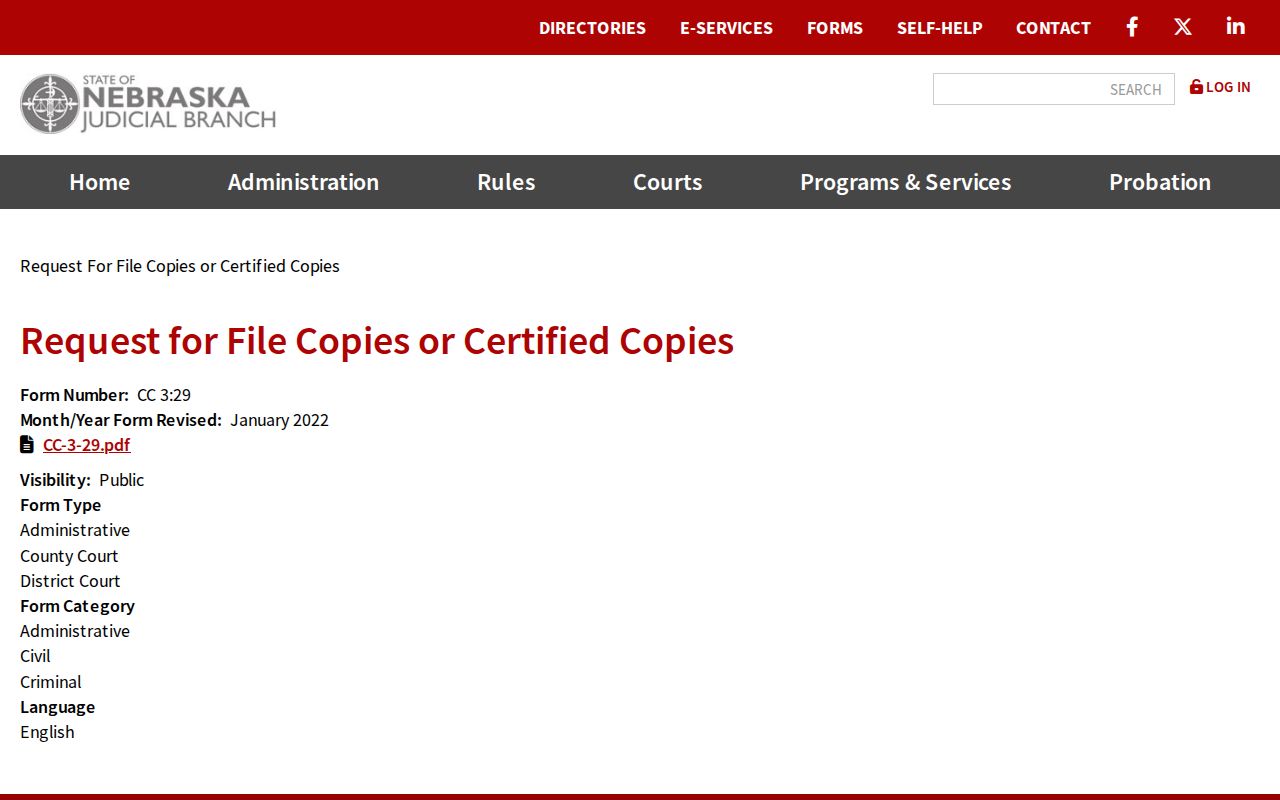
A docket entry is only a line on the court's list. On the form, describe the document behind that entry rather than the entry itself.
Types of Hooker County Court Records
"Court record" covers a lot of ground in Hooker County. It can mean an index entry. It can mean a case summary, the ROA, a filed paper, an order, a judgment, a financial ledger, an image, a recording, or a transcript. Each item has its own access rules. Each has its own custodian. JUSTICE may display a public case summary and parties. It may also show public offense information, financial information, ROA entries, public judge notes, and available nonconfidential electronic images. The original paper file or a clerk-certified copy is a separate request entirely.
- Case summaries and ROAs that list filings, hearings, orders, and other recorded events.
- Pleadings, motions, answers, complaints, and public document images where available.
- Orders, judgments, sentencing documents, and certified dispositions held by the appropriate clerk.
- Financial records such as assessed costs, payments, and judgment entries when public.
- Hearing recordings and typed transcripts, which use a different request process from a file copy.
Hooker Court Records by Custodian
Both clerks sit in the Hooker County Courthouse. But no combined court file exists between them. Ask for the County Court Clerk Magistrate when the case is a county-court matter. Ask for the District Court Clerk when it is a district-court case. The split holds even when the search result lists a similar case type. County court covers the usual traffic and ordinance lane. A felony filed in district court belongs with the district clerk. A request that just says "criminal record" can easily land on the wrong records desk.
The Hooker County Court page lays out the county-court categories. The Hooker County Clerk of District Court page describes the district clerk's record, judgment, and certification role. Trial-court records stay separate from federal cases, too. A federal matter with a Hooker party is searched through the federal court system. It does not sit in the Hooker court file.
What a Hooker County Court Record Contains
The case number is the first identity check on any Hooker County docket entry. It carries the court prefix, county number, case type, year, and sequence. Yet it still needs to be matched against the caption and each party's role. The ROA lists case events in order. It is not a transcript. A payment entry does not automatically equal a final result. Public images can be incomplete for many reasons. Filing date, confidentiality, sealing, document type, or conversion history all play a part.
| Case Number | A code such as D93 CI-14-0000019 identifies court, county, type, year, and sequence. |
|---|---|
| Case Summary | Caption, parties, case type, court, and other public summary fields. |
| ROA | A dated sequence of filings, hearings, orders, and recorded case events. |
| Filed Documents | Public pleadings, orders, judgments, and images when the item is available and unrestricted. |
| Financial History | Public assessments and payment entries, which should be read separately from a disposition. |
Hooker Court Transcript and Recording Requests
Three different products answer three different questions. A hearing recording, a typed transcript, and the ROA each serve a purpose. Nebraska's county-court rule requires that proceedings be recorded. But a written transcript is something else. A reporter or transcriber prepares it separately, and it does not simply appear in the file. When you ask for one, give the hearing date, time, location, and judge, say whether you need the whole proceeding or part, and list any exhibits that matter. The reporter or transcriber estimates the cost under the applicable rule before work begins. A nonparty may also need a judge's approval. Nebraska's typed-transcript guidance explains the hearing-by-hearing request route.
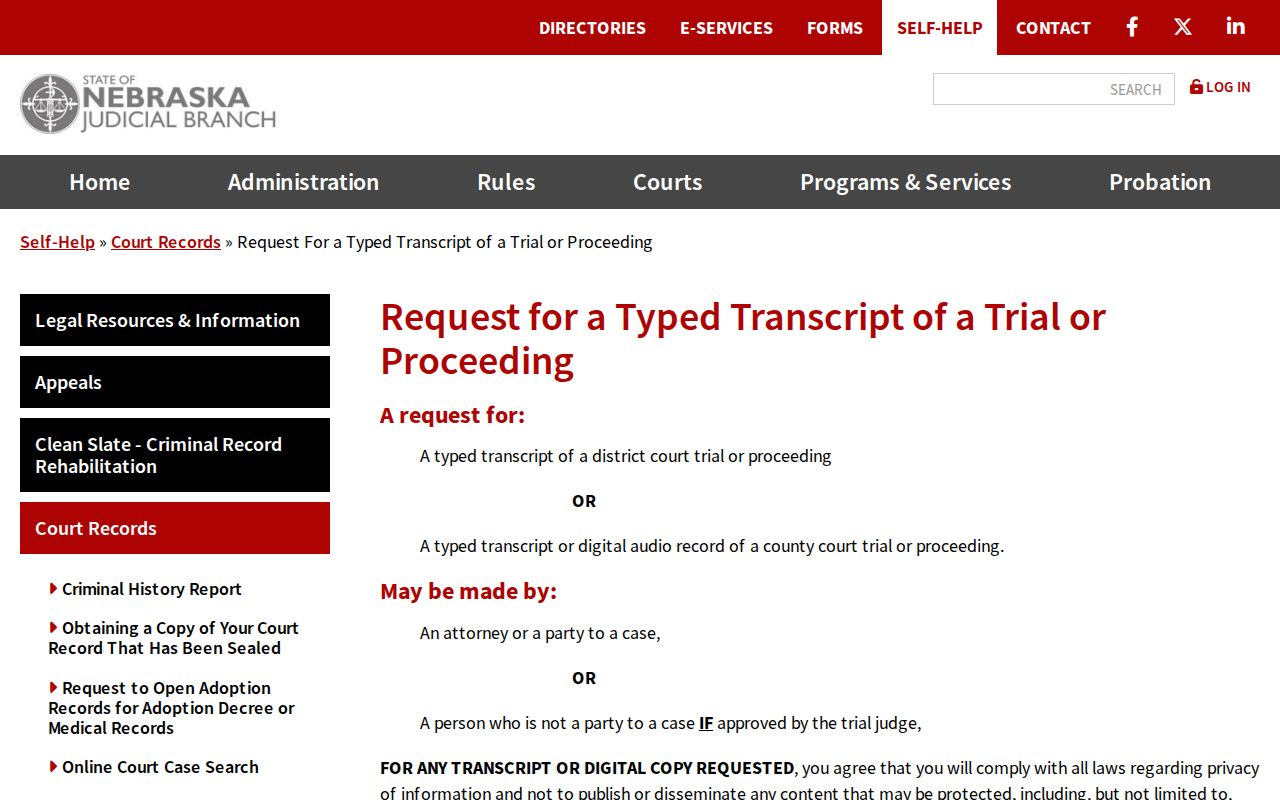
Use form CC 1:14 when you need a proceeding put into written transcript form. For a court-file copy or a certified copy, form CC 3:29 is the one to use.
Certified Copies and Fees
A plain electronic copy is fine for reading. It carries no clerk's assurance of authenticity. Certified copies are different: the clerk certifies them, often with a seal. That stamp adds trust, not facts. Tell the clerk which product you need before work begins. Sealed, unavailable, or out-of-custody items cannot be certified. If a service falls outside the CC 3:29 choices below, the current court fee schedule controls.
| Item | Amount |
|---|---|
| Emailed noncertified electronic copy | No charge |
| Mailed noncertified copy | $0.25 per page |
| Emailed certified request | $1 per request |
| Mailed certified copy | $1 per seal plus $0.25 per page |
Hooker County Court Clerk Magistrate
303 NW 1st Street
Mullen, NE 69152
308-546-2249
Hooker Court Records That Are No Longer Available
A docket search that returns nothing does not prove a case never existed. The file may sit outside JUSTICE for many reasons. A misspelled name or the wrong court or year can hide it. So can a data lag, gaps in image coverage, confidentiality, sealing, a transfer, or retention limits. For older Hooker County cases, ask the clerk directly. Be specific about which court, years, case type, and identifiers were searched. Then ask whether the item is missing from the online system, the physical file, or the court's custody entirely. The courts do not usually certify "no record" off a broad search. A clerk can still explain the result or give an appropriate public-records response. The Judicial Branch's records-availability explanation names retention, court rules, and sealing as common limits on what a court records request can produce.
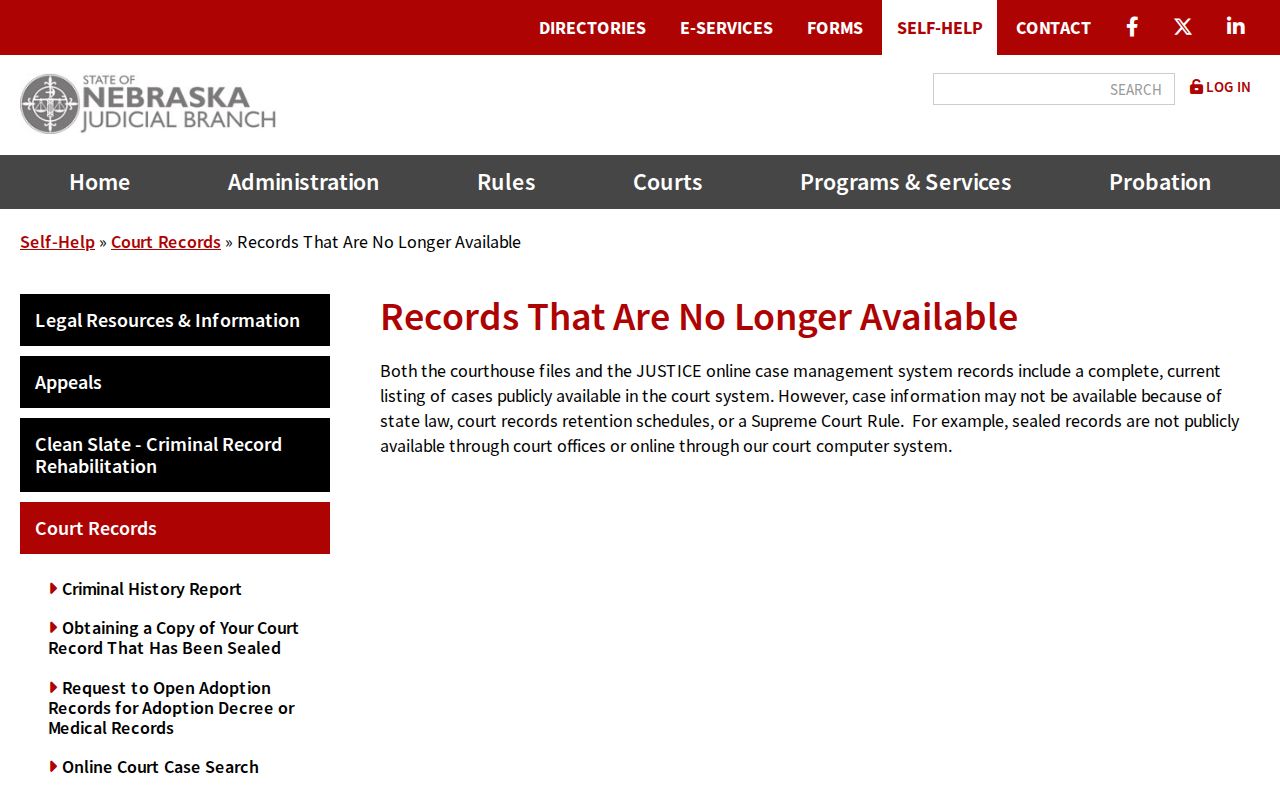
This is why a precise request matters. Ask the clerk to state the reason an item cannot be supplied. Nebraska's retention and disposition schedules give the current schedule route for court records.
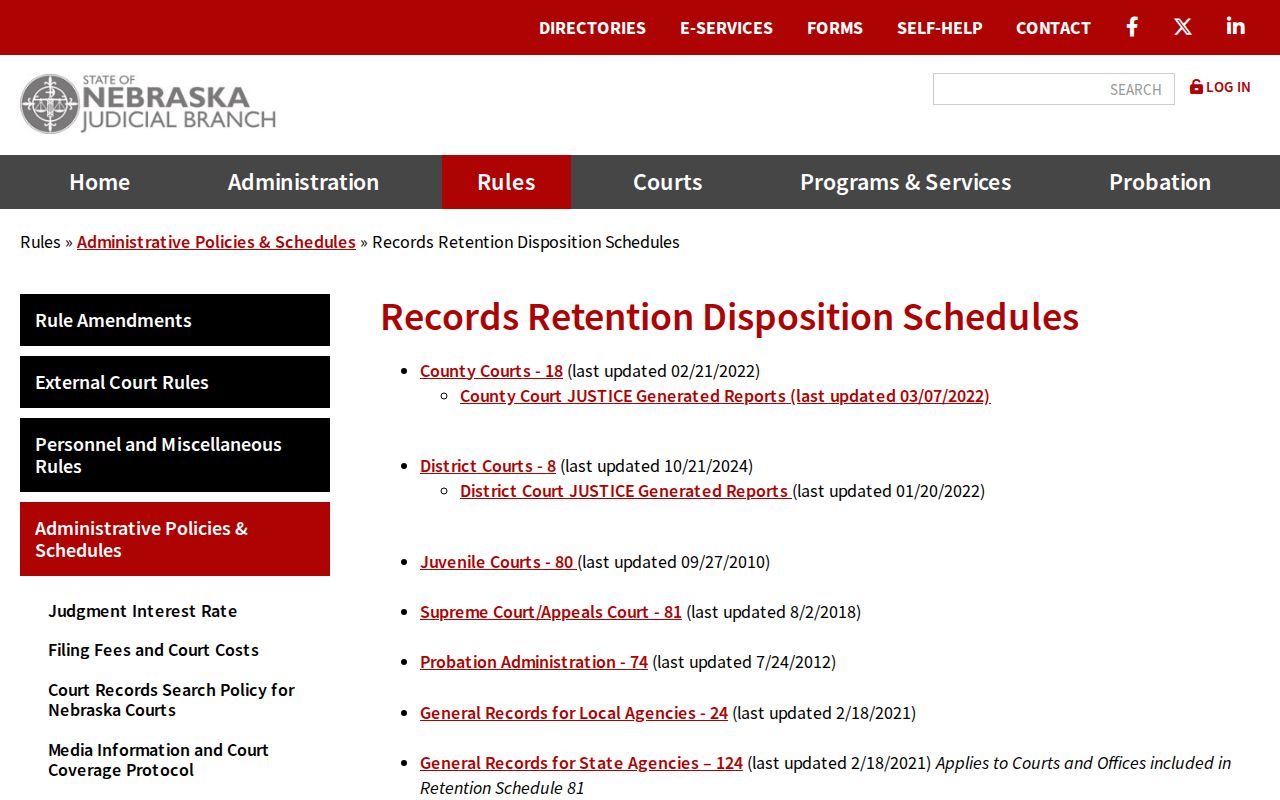
County-court traffic-related records may be destroyed five years after satisfaction or dismissal under the destruction notice. That notice alone does not establish the status of any particular Hooker County file.
Public Access and Sealed Records
Nebraska court records are open by default. A statute, a court rule, a court order, or a confidential status can still close them. Electronic access has its own limits. Public electronic access does not make every item in a case file public. Paper records never converted to electronic form sit outside the electronic-access provision. An online index for the court docket does not promise a full file. It may not carry an image of every pleading, exhibit, audio file, or older paper file. Juvenile records carry separate protections. Sealed adult matters do not surface through JUSTICE. Nebraska public-access Rule 1-803 sets the framework that governs electronic access to court records.
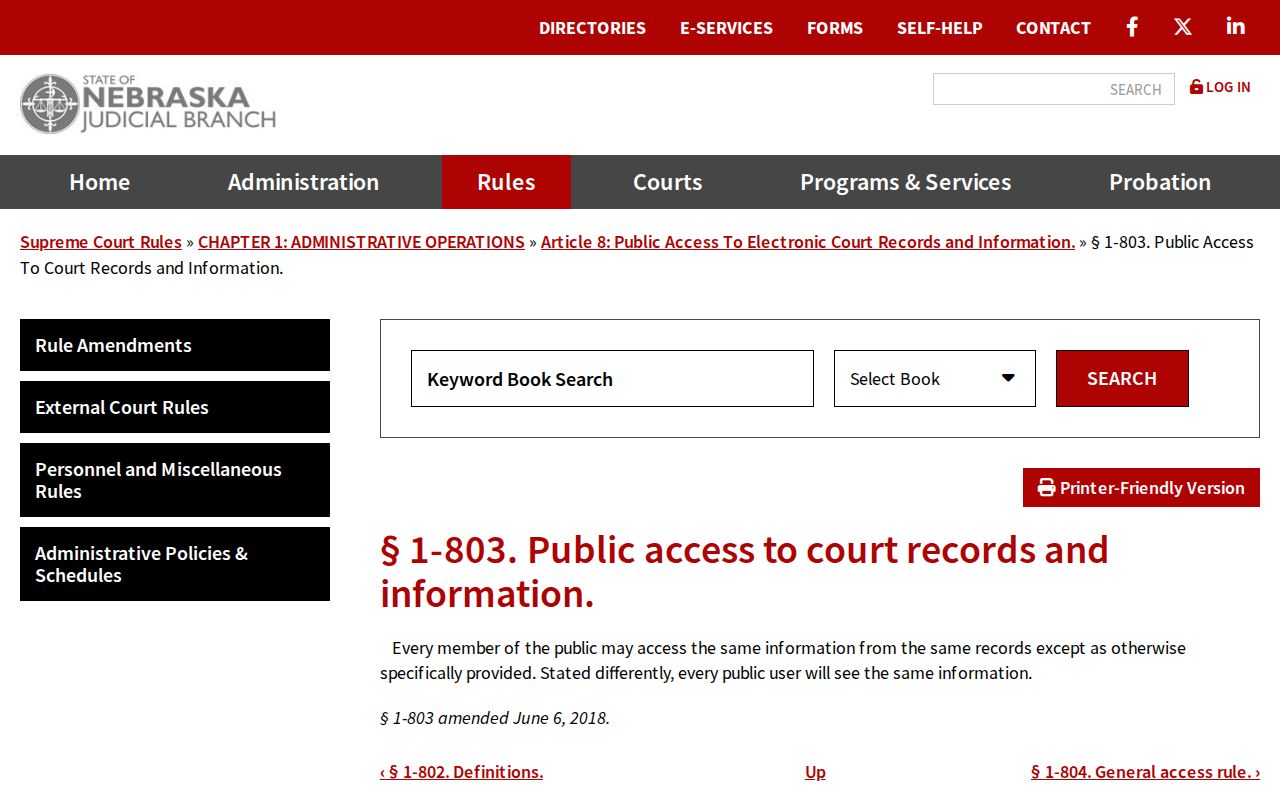
Public access is the default under this rule. Sealed material stays sealed. A law, a court rule, or a judge's own order can keep it that way. A Hooker County court docket may show that a filing exists. Its contents can still stay off limits to the public.
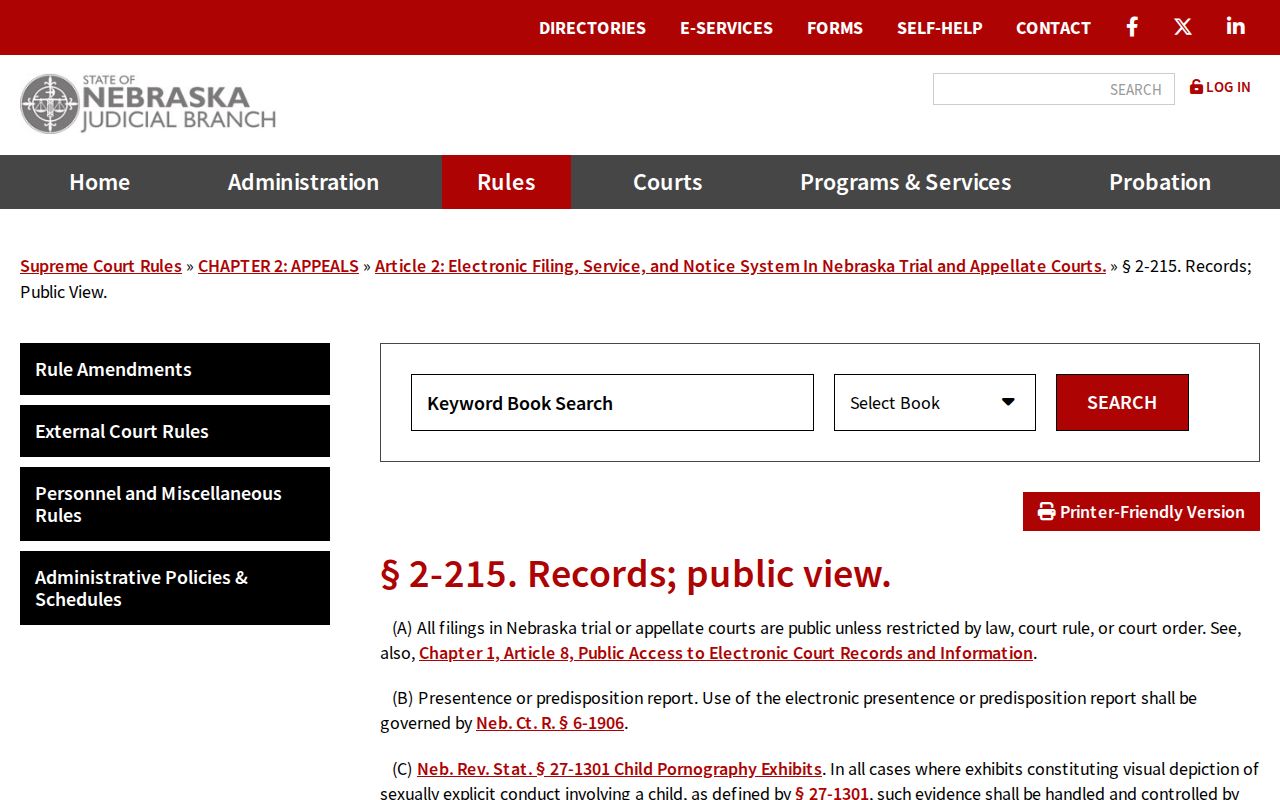
For the official text on how e-filed records carry their public status, see Rule 2-215 on records public view.
Access limited? Ask the clerk whether a statute, a rule, an order, or another office controls that record.
Key Rules:
Neb. Rev. Stat. §84-712 gives a public right to examine and copy public records, subject to lawful exceptions and court-specific rules.
Neb. Rev. Stat. §84-712.01 defines public records to include government records and public computer files.
Neb. Rev. Stat. §43-2,108.05 limits release of sealed juvenile records to specified authorized persons or entities.
Hooker County Records Requests Under Public Records Act
The Nebraska Public Records Act opens one more door. It works well for county-held records. It also covers anything sent to the department in charge. Not sure which department holds the file? Hooker County's FAQ says the County Clerk may forward a request along. For a court case file, though, go straight to the right court clerk. That keeps "docket" from being read as some non-court county record. The county's general route also never demands a statement of purpose.
§84-712 sets the clock. The office must respond as soon as practical. That means no later than four business days. What counts as a response varies. It may grant access, or estimate time and cost for a large request. It may deny with its legal basis stated, or explain a delay. None of that overrides sealing, confidentiality, retention, or a court rule. For the fastest usable reply, name the court, the case, and the document. Add your preferred format, your contact details, and your willingness to pay the lawful estimate. A Hooker County case search can pin down those identifying details first. File the request after that.